Rebuilding childhood with play
A scalable solution for crisis affected learners

Supported by Grand Challenges Canada, with funding from the LEGO Foundation.
Years of economic collapse, displacement, conflict and school closures have left many primary school children in Lebanon far behind. Rebuilding is especially hard in a country where power cuts and internet outages are part of daily life. In response, the Ministry of Education and Higher Education (MEHE) launched a national learning recovery program for primary students who have fallen behind.
Rebuilding Childhood Through Play is LAL’s contribution to that national effort. Working with MEHE and the Center for Educational Research and Development (CERD), we are aligning Tabshoura, our free, trilingual digital learning platform, with Lebanon’s national learning recovery framework, so that children can rebuild their foundations through playful, discovery-based learning at their own pace.
What the project does
Adapts Tabshoura for recovery. We are adapting Tabshoura’s content and learning pathways to the national recovery framework and developing aligned digital assessments. This helps each child work on the specific gaps they need to close.
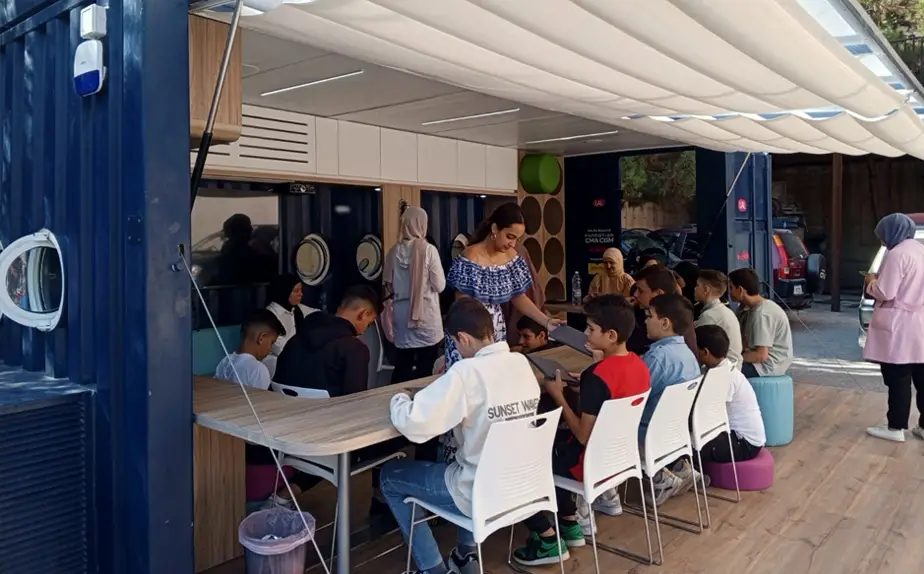
Brings it to schools and communities. We plan to deploy Tabshoura in 30 schools and 5 Alternative Learning Spaces, and to train 1,000 educators in recovery-aligned instruction through Lalmoudaress, our teacher support platform.
Strengthens monitoring. We are aligning our monitoring and evaluation tools with national frameworks, so that progress can be tracked and reported consistently.
Builds for the long term. We are working with MEHE on technical coordination and sustainability planning, so that the solution can be integrated into recovery efforts nationwide.
Designed for Lebanon’s reality
Tabshoura works offline, through its mobile app and through Tabshoura-in-a-box, a portable server that hosts the entire platform with no need for the electricity grid or the internet. Alternative Learning Spaces, run by trained local educators in public schools and community centers, bring learning close to where children live. For families, this means a self-paced, low-stress path to catching up, recognized by the national education system.
